
MRO Simulation

Organizations across aerospace, defense, and complex industrial systems have made substantial investments in Model-Based Systems Engineering (MBSE) using SysML. These models capture functional intent, logical architectures, and system interactions early, where design decisions matter most.
Yet in many programs, reliability, availability, maintainability, and safety (RAMS) analysis remains disconnected from that work.
Reliability engineers are often forced to recreate system architectures manually inside downstream tools, duplicating effort and introducing lag between design intent and reliability insight. The result is predictable: RAMS analysis arrives late, costs more than it should, and struggles to influence decisions when change is still affordable.
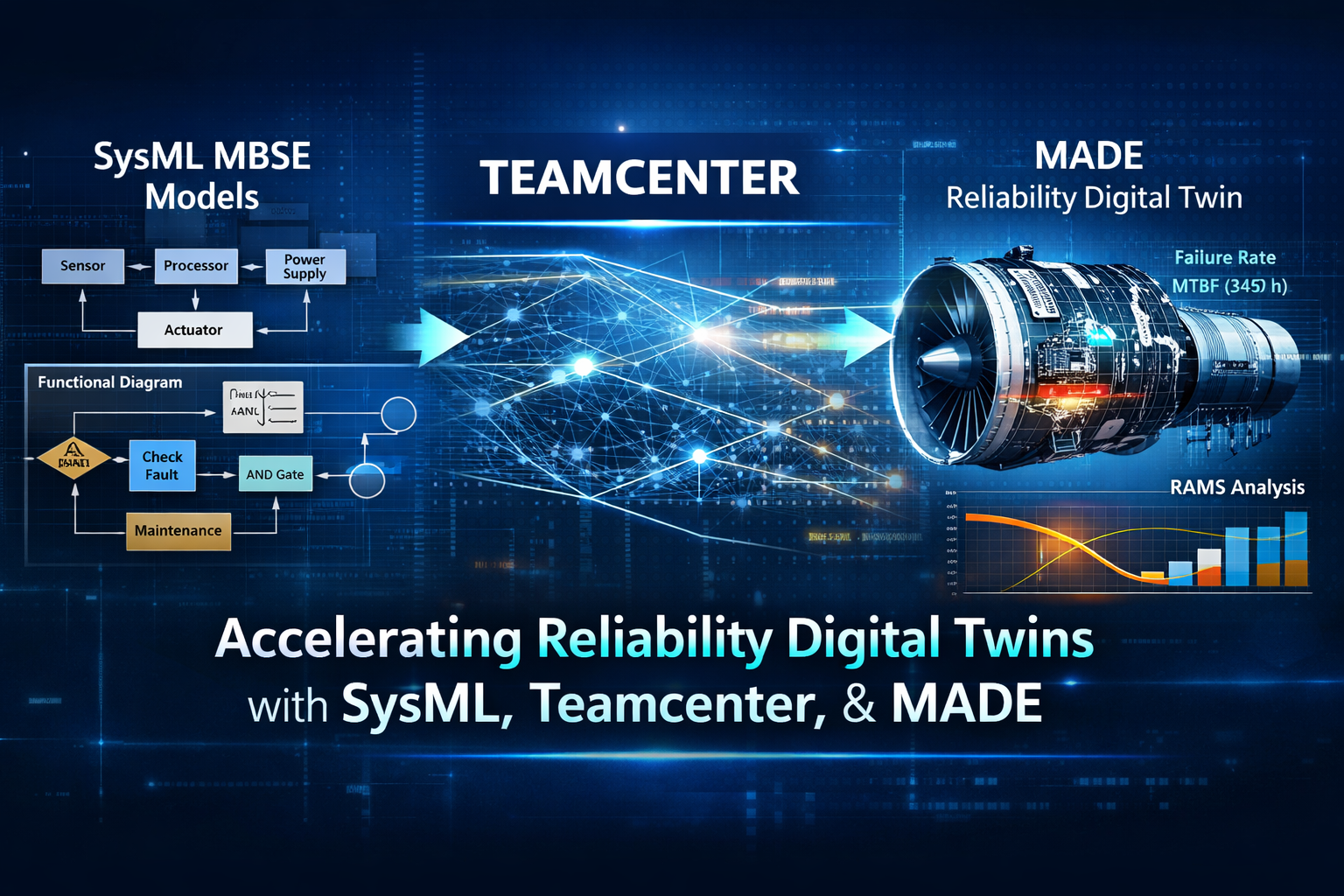
New capabilities in Siemens Teamcenter 2512, combined with Maintenance Aware Design Ecosystem (MADE) software, finally allow organizations to close this gap by reusing SysML MBSE models as the foundation of reliability models for RAMS analysis.
This page explains why that matters, what value it unlocks, and how Skypath Analytics helps organizations realize it.
A reliability digital twin, which is a reliability model of a system, is only as good as its underlying system model. In theory, MBSE should provide that model. In practice, several barriers have historically stood in the way:
SysML models were difficult to consume outside MBSE tools
PLM systems stored geometry and documents, not system logic
Reliability tools required custom-built functional architectures
As a result, reliability modeling became a parallel activity, disconnected from the authoritative product definition.
This disconnect has real consequences:
Time: Reliability models take weeks or months to build
Risk: Architecture interpretation errors creep in
Relevance: Analysis lags behind design evolution
ROI: MBSE investment fails to compound downstream
The issue was never reliability methodology. It was model continuity.
A reliability digital twin is not a static reliability calculation. It is a living analytical representation of system behavior over time, incorporating:
Functional and logical architecture
Failure modes and rates
Maintenance and operational concepts
Usage profiles and environmental conditions
When built early and kept in sync, reliability digital twins enable:
Design trade studies with quantified availability impact
Sustainment strategy evaluation before fielding
Early identification of reliability drivers
Faster, more defensible decision-making
But these benefits depend on speed and alignment, both of which suffer when models are rebuilt manually.
Teamcenter 2512 introduces a critical capability: enterprise system data models derived from SysML.
When SysML MBSE models are stored and managed in Teamcenter:
Functional and logical system structures are captured in a system data model
These structures are configuration-controlled alongside the product definition
Downstream tools can consume them directly
This transforms SysML from an engineering artifact into enterprise data.
For reliability teams, this means:
No blank-sheet modeling
No manual re-interpretation of architectures
No guesswork about design intent
The system definition becomes shared, authoritative, and reusable. This is one of the goals of digital engineering.
MADE is purpose-built for RAMS analysis and reliability digital twins, but model creation has traditionally been the bottleneck.
With Teamcenter acting as the bridge:
Functional architectures and logical components flow into MADE
Reliability engineers start with a structured, MBSE-derived foundation
RAMS analysis builds directly on system intent
This changes the economics of reliability modeling.
Instead of spending the majority of effort on model construction, teams focus on:
Failure behavior
Maintenance strategy
Operational impact
Decision insight
In short: less modeling overhead, more engineering value.
Across programs leveraging SysML-to-Reliability-Model workflows via Teamcenter, organizations typically realize:
40–60% reduction in reliability model development time
RAMS analysis initiated earlier in the design lifecycle
Direct alignment with system architecture
Reduced interpretation and translation errors
Higher confidence in results
Reliability models stay aligned with evolving designs
Less rework when architectures change
Clear traceability to product definition
MBSE models drive downstream analysis, not just documentation
Engineering data compounds across lifecycle phases
For aerospace and defense organizations, reliability is not an abstract metric, it is a mission enabler.
Late reliability insight leads to:
Expensive redesigns
Sustainment cost growth
Availability shortfalls
By leveraging SysML MBSE models to accelerate reliability digital twins:
Reliability becomes a design input, not a post-hoc assessment
Sustainment strategies are evaluated earlier
Decisions are supported by quantified risk
This is how digital engineering delivers operational value—not just compliance.
Many organizations have attempted to connect MBSE and reliability before—and failed.
Common reasons:
One-off integrations
File-based handoffs
Manual synchronization
Lack of enterprise ownership
What’s different now is structural integration:
Teamcenter manages the authoritative system definition
MADE consumes system architecture as data
Synchronization replaces manual rebuilds
This is not a workaround. It is a scalable pattern.
SkyPath helps organizations capitalize on this integration, without forcing internal teams to become tool-integration experts, or waiting on their enterprise systems to catch up to the latest capabilities.
Our focus is not software configuration for its own sake. It is:
Accelerating reliability digital twin development
Reducing modeling effort and cycle time
Improving RAMS decision quality
Ensuring alignment with enterprise digital engineering strategy
We work where MBSE, PLM, and RAMS intersect, so reliability insight arrives faster, earlier, and aligned.
SysML models capture how systems are intended to work.
Reliability digital twins reveal how they actually behave over time.
With Teamcenter and MADE, those worlds no longer need to be separate.
Organizations that connect them will:
Make better design decisions
Reduce lifecycle cost and risk
Extract real ROI from MBSE
That’s the difference between modeling systems and engineering outcomes.
Many defense programs already have SysML MBSE models in place. Far fewer are extracting real value from them in reliability, availability, and sustainment decisions.
SkyPath helps DoD organizations and defense contractors bridge that gap.
We specialize in leveraging existing MBSE artifacts to rapidly develop reliability digital twins in MADE, reducing model build time, improving fidelity, and keeping RAMS analysis aligned with the authoritative product definition in Teamcenter.
Accelerated creation of reliability digital twins using existing SysML MBSE models
RAMS analysis that stays synchronized with evolving system designs
Earlier, defensible reliability insight to support design trades and sustainment planning
Reduced modeling rework and improved configuration traceability
Program Offices and PEOs seeking earlier reliability insight
Sustainment and logistics organizations focused on availability and lifecycle cost
Prime contractors implementing MBSE and digital engineering at scale
SkyPath brings deep experience at the intersection of MBSE, PLM, and RAMS analysis in defense environments. We don’t just understand the tools—we understand how reliability decisions are made, reviewed, and defended across the lifecycle.
Our work helps programs move reliability left (earlier), reduce downstream risk, and extract real ROI from digital engineering investments.