
Reliability
MRO Simulation
MBSE
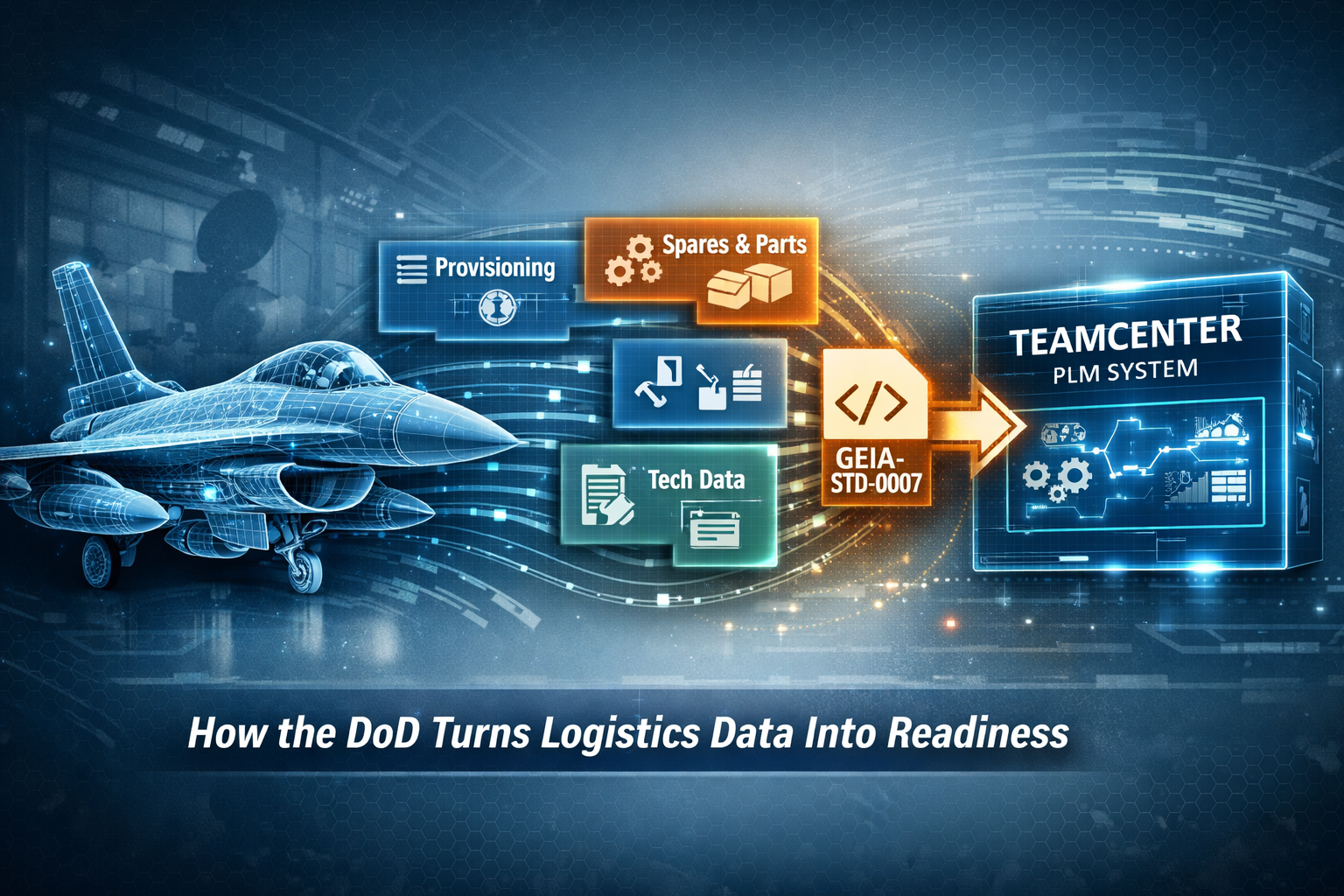

The U.S. Department of Defense (DoD) is entering a new era of digital sustainment. Digital engineering, digital twins, model‑based systems engineering (MBSE), and AI‑enabled analytics are rapidly changing how weapon systems are designed and maintained.
Yet one critical piece of the lifecycle is still holding many programs back: Product support data.
Maintenance planning, provisioning, spare parts forecasting, and sustainment decisions all depend on structured logistics data. Unfortunately, that data is often:
Stored in disconnected spreadsheets
Generated too late in the lifecycle
Poorly aligned with engineering designs
Difficult to trace or reuse
This is where Product Support Data Management (PSDM) comes in.
PSDM is the discipline—and increasingly the platform capability—that allows the DoD to treat logistics product data as a first‑class digital asset, integrated directly with engineering definitions and operational systems.
In this article, we will explain:
What PSDM is
Why it matters across the DoD
How standards like GEIA‑STD‑0007 enable it
How the U.S. Department of Defense can using PLM platforms like Teamcenter to operationalize PSDM
And why PSDM is foundational to the future of digital sustainment
Product Support Data Management (PSDM) is the structured, governed, and traceable management of logistics product data across the lifecycle of a system.
It focuses on the data that answers questions like:
What parts does this system require to be supported?
How often do those parts fail?
What maintenance actions are required?
What support equipment, manpower, and spares are needed?
How does this data change as the system evolves?
PSDM is not just a database.
It is:
A data architecture
A governance framework
A digital thread that connects engineering, sustainment, and operations
At its core, PSDM manages the data produced by Product Support Analysis (PSA)—the modern evolution of Logistics Support Analysis (LSA). It is incredibly valuable data, but is currently underutilized, disconnected from other product data, and stored in its own data silo.
Every DoD weapon system lives far longer in sustainment than in development. For aircraft, ships, and ground systems, 70–80% of lifecycle cost occurs after fielding.
Yet programs tend to still treat product support data as:
A contractual deliverable
A compliance artifact
A static handoff at IOC
Instead of a living, operational data set.
This creates real problems:
Poor sparing forecasts
Obsolete parts with no digital traceability
Maintenance plans that no longer match the configuration
Long cycle times to assess changes
Manual re‑work between systems
The result is lower readiness, higher cost, and slower modernization.
PSDM fixes this by making logistics data part of the digital backbone of the program.
To manage product support data at scale, you must standardize it.
That is the role of GEIA‑STD‑0007: Logistics Product Data.
This standard defines:
A common data model for logistics product data
Relationships between systems, parts, maintenance tasks, and support resources
A machine‑readable structure (XML) that can be exchanged between tools
GEIA‑STD‑0007 replaced the legacy MIL‑STD‑1388‑2B LSAR and modernized it for the digital era.
Instead of flat tables, it provides a relational, object‑based schema that supports:
Configuration traceability
Versioning
Automation
Interoperability
In practical terms, GEIA‑STD‑0007 defines how the DoD should digitally represent:
LCN structures
Part breakdowns
SMR codes
Maintenance tasks
Support equipment
Manpower requirements
Failure modes
Provisioning data
Without this structure, PSDM cannot scale.
PSDM is no longer optional.
Across the DoD—and especially within the U.S. Air Force—policy is pushing logistics data into the same digital ecosystem as engineering.
Key drivers include:
DoDI 5000.91 – Requires integrated product support planning and data management
AFI 63‑101 / 20‑101 – Mandates digital lifecycle management in the Air Force
AFI 23‑101 – Governs materiel and provisioning processes in the Air Force
AFMCMAN 20‑106 – Directs how provisioning and product support data is generated in the Air Force
Together, these policies require programs to:
Digitally manage product support data
Ensure traceability to the technical baseline
Enable reuse across sustainment systems
Support analytics and decision‑making
PSDM is the operational response to those requirements, and is the solution that can enable a powerful integration between the product engineering definition and the logistics analysis needed to sustain it.
GEIA‑STD‑0007 is not just a “best practice” standard—it is the de facto logistics product data model required across DoD acquisition and sustainment through a chain of policy, guidance, and contractual data requirements.
While no single DoD Instruction says “you must use GEIA‑STD‑0007,” multiple binding policies require standardized, digital, and exchangeable logistics product data—and GEIA‑STD‑0007 is the only DoD‑recognized standard that fulfills those requirements.
Here’s how the mandate works.
DoDI 5000.91 requires that programs:
Develop and maintain product support strategies
Digitally manage sustainment data
Enable life‑cycle configuration traceability
Support data reuse across the lifecycle
It explicitly requires that product support data:
“Be structured, traceable, and managed in a manner that enables life cycle analysis, sustainment planning, and operational readiness.”
GEIA‑STD‑0007 is the only DoD‑recognized standard that defines this data structure.
This instruction requires:
Digital engineering
Model‑based analysis
Data-driven decision support
It further requires that sustainment data be:
Digitally managed
Linked to the system baseline
Structured for reuse and analytics
GEIA‑STD‑0007 provides the data model that allows logistics data to exist in a digital engineering ecosystem.
This Air Force instruction mandates that:
Programs implement digital lifecycle data strategies
Sustainment planning data must be traceable to configuration
Logistics data must support readiness analytics
The only logistics data structure that supports this level of traceability is GEIA‑STD‑0007.
AFI 23‑101 governs provisioning and materiel management in the Air Force and requires:
Standardized product support data
Digital provisioning records
Configuration‑controlled parts data
The Air Force provisioning community uses GEIA‑STD‑0007 data structures as the authoritative source for provisioning and SMR codes.
This manual explicitly requires:
Structured provisioning and maintenance data
Machine‑readable deliverables
Traceability to the technical baseline
The Air Force provisioning community implements this through GEIA‑STD‑0007‑compliant data sets.
This policy is consistent and there is an accepted standard for creating this structured data. That is huge and a great advantage that can be leveraged for even more benefit in this age of digital engineering, digital sustainment and the emergence of artificial intelligence.
In the past, product support data lived in:
Standalone provisioning tools
Depot spreadsheets
Contractor databases
Today, PSDM is moving into Product Lifecycle Management (PLM) systems. For the U.S. Air Force, that system is increasingly Teamcenter.
Teamcenter acts as the digital backbone connecting:
Engineering BOMs
Manufacturing structures
Configuration baselines
Technical publications
and soon, service records (with Service Lifecycle Management)
When PSDM is implemented in PLM:
Logistics data is no longer isolated
It is linked directly to the digital definition of the system
Changes propagate across the lifecycle
This is what enables a true digital thread for sustainment. Read that again. A true digital thread for sustainment.
Teamcenter’s Service Lifecycle Management (SLM) module extends PLM into sustainment.
When combined with PSDM capabilities, it allows programs to:
Import GEIA‑STD‑0007 logistics data
Map it to Service BOMs
Associate it with serialized assets
Track configuration and maintenance history
Support maintenance planning and analytics
In other words: It connects what the system is to how it is supported. This is a major shift from static LSARs to living logistics models.
Across multiple Air Force programs (including aircraft and ISR platforms), Teamcenter is now the system of record for:
Engineering configuration
Digital manufacturing
Service planning
Sustainment baselines
By integrating GEIA‑STD‑0007 data into Teamcenter using the Service Lifecycle Management module:
Provisioning data becomes part of the configuration
LCNs map to real part numbers
Maintenance tasks link to real hardware
Changes to design trigger supportability analysis
This closes the gap between: Design → Support → Operations
PSDM is powerful—but not simple. Common challenges include:
Incomplete provisioning data
Inconsistent part identifiers
Poor configuration discipline
XML schema errors
Manual mapping between systems
Most programs discover that:
Their biggest problem is not tools—it is data readiness.
PSDM exposes weaknesses that already exist.
Digital twins, AI maintenance, predictive logistics, and readiness analytics all depend on structured product support data.
Without PSDM:
Your digital twin is blind to sustainment
Your analytics are disconnected from configuration
Your readiness forecasts are guesses
With PSDM:
You can simulate sustainment impacts
Predict spare demand
Optimize maintenance intervals
Identify failure drivers
PSDM is not just compliance—it is a strategic advantage. A true digital thread for sustainment would be structured and AI ready. The technology exists right now to start implementing this functionality to integrate logistics data into digital engineering definitions. Yes, it will require time and effort, but the sooner we start, the sooner DoD can leverage this capability into increased readiness and lower costs.
What does PSDM stand for?
Product Support Data Management.
What standard defines PSDM data?
GEIA‑STD‑0007: Logistics Product Data.
Is PSDM required by the DoD?
Yes, through acquisition, logistics, and data policy, principally DoDI 5000.91, which requires integrated product support planning and data management.
How does PSDM connect to Teamcenter?
Through the Teamcenter Service Lifecycle Management module and PSDM import/mapping capabilities in TC2512.
In the next post, we will break down GEIA‑STD‑0007 in detail—what data it contains, how it is structured, and how logistics analysts actually use it.
If your program is serious about digital sustainment, PSDM can take it to the next level.
We can provide PSDM training for Teamcenter SLM. Contact us to learn more!